
Valor Mortis weapons: melee blades, flintlock firearms, Transmutations and Catalyst skill trees.
Valor Mortis Weapons & Builds: Blades, Guns, Transmutations
Valor Mortis is a melee-first soulslike: blades do the heavy lifting, flintlock pistols and muskets act as scarce-ammo support tools, and supernatural Transmutations plus Catalyst perks and Ambers shape your build. There is no confirmed class system, and no official full weapon list with stats has been published as of October 10, 2026, three days before the store-listed launch on October 13.
How Builds Work in Valor Mortis
Every build in Valor Mortis combines four confirmed layers, based on the official overview trailer as reported by GamingBolt ahead of launch. You pick a blade as your primary weapon, carry a firearm for high-value shots, unlock Transmutations as supernatural abilities, and tune everything with Catalyst perks and build-altering Ambers.
| Build layer | What it does (confirmed so far) | Where you manage it |
|---|---|---|
| Melee blade | Primary damage; each blade has its own weight and handling | Weapon skill tree |
| Flintlock firearm | Pistols and muskets for support shots; ammunition is scarce | Weapon skill tree |
| Transmutations | Supernatural powers such as palm flames and a traversal grapple | Discovered through progression |
| Catalysts + Ambers | Perk points plus passive modifiers that usually carry trade-offs | Lanterns (bonfire checkpoints) |
Progression runs through lanterns, the bonfire-style checkpoints where resting replenishes healing vials and respawns enemies. Interacting with lanterns lets you upgrade William's core stats, while each weapon has its own levelling tree, so committing to a favourite blade or firearm is how builds take shape. New to the game's fundamentals? Our Valor Mortis combat guide explains the parry, posture, and execution loop these builds are built around.
Official source: Valor Mortis on Steam
Melee Blades: The Core of Every Build
Melee is the main focus of combat. As GamingBolt's pre-launch breakdown puts it, guns are useful tools, but together with cold steel and supernatural powers a continuous flow emerges, and your firepower is not designed to replace your swordplay. That single sentence settles the most common new-player question: pick the blade first, and treat everything else as support.
Specific blade names confirmed so far are limited. The names claymore, rapier, and sabre have surfaced through reports on the Deluxe edition's weapon skin packs, which reportedly cover the pistol, musket, claymore, rapier, and sabre. Those reports are second-hand, confirming weapon families without stats or movesets; a complete table must wait for launch verification.
What is confirmed about blades is how they feel: each has its own weight and purpose, changing your positioning fight to fight, and immediate counterattacks replenish spent health, rewarding aggression over retreat. To practise that timing, the General Lothaire demo boss fight is the best-documented sparring partner available before launch.
Flintlock Firearms: Pistols, Muskets and the Blunderbuss
Firearms in Valor Mortis mean flintlock pistols and muskets: slow, deliberate weapons rather than anything resembling a modern shooter arsenal. Ammunition is scarce by design, so every shot has to earn its place, whether that means finishing a weakened enemy, interrupting an attack, or striking a weak point. Pre-release coverage of mini-bosses specifically calls out weak-point targeting as a mechanic to watch, which is where a saved bullet pays off most.
The name Blunderbuss has surfaced in third-party trophy reporting tied to a trophy called Scattershot. That list is disclosure rather than an official weapon reveal, so treat the Blunderbuss as strongly rumoured, and ignore any pre-launch firearm stats from forums or placeholder wiki pages.
Based on the demo and pre-release coverage, guns work best as punctuation: one aimed shot into a weak point or a dangerous wind-up, then back to the blade. Spraying shots at regular enemies wastes the scarcest resource in your kit.
The practical takeaway for build planning is that firearms support every build rather than defining one. There is no confirmed pure-gunslinger path in the published material, and the ranged damage role partly belongs to Transmutations instead. For how scarce ammo shapes moment-to-moment decisions, read our beginner tips.
Transmutations: Palm Fire, Crowd Control and the Grapple
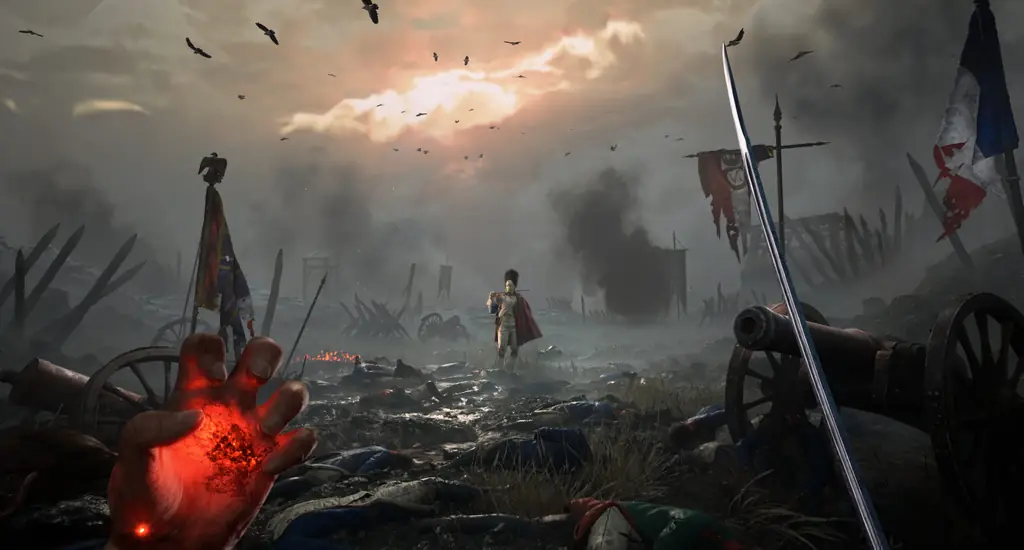
Transmutations are William's supernatural abilities, fuelled by a power called Nephtoglobin gained after his resurrection. Gameplay descriptions mention flames bursting from his palms for ranged attacks and crowd control, plus a traversal grapple. Footage shows a grapple line firing from his hand to swing across gaps, and Nephtoglobin can reportedly conjure temporary platforms as well.
How Transmutations are unlocked and upgraded remains unconfirmed in the published material. The full Transmutation list, like the weapon roster, is a post-launch job.
Catalysts, Skill Trees and Ambers: Where Builds Come From
Catalysts are perk points that enhance specific properties, with melee damage as the confirmed example. They are the fine-tuning layer: small improvements that push a build toward harder hits, better stamina, or sharper parries.
The broader picture has two halves. William has a skill tree upgraded at lanterns, with nodes reported to cover stamina regeneration, parrying efficiency, and health. Each weapon separately has its own levelling tree. Milestones unlock accessory slots for Ambers, the passive modifiers officially described as build-altering. Our Ambers equipment guide covers the lantern-and-socket mechanic in full.
If you played the now-offline Steam demo, note it covered only an early combat chapter and one harder Transmutation chapter, so demo impressions cover a fraction of these systems. Our demo guide recaps exactly what was in it.
Three Starter Build Directions
No tested launch meta can exist before October 13, so treat these as directions suggested by the confirmed systems, not ranked recommendations. Each leans on a different confirmed layer while keeping the blade as the foundation.
| Direction | Core idea | First priorities at lanterns | Suits players who |
|---|---|---|---|
| Blade Aggressor | Lean into counterattack healing and posture breaks with your heaviest comfortable blade | Melee damage Catalysts, health and stamina nodes | Like trading hits and staying in the enemy's face |
| Gun Opportunist | Same blade-first core, but bank ammo for weak points, interrupts, and mini-boss phases | Parry efficiency plus whatever gun tree nodes appear first | Prefer patience, observation, and single decisive shots |
| Transmutation Weaver | Mix palm flames and crowd control into melee chains; chase mobility unlocks early | Magic-adjacent Ambers and stamina regeneration | Want variety and traversal options over raw damage |
Whichever direction appeals, the demo-era consensus from preview coverage is that parry timing and stamina discipline gate everything else. A build only works if its pilot can survive long enough to execute it, so keep one eye on defence while spending on offence.
What Is Not Confirmed Yet
Honesty matters more than completeness three days before launch. The following are not confirmed in any official or reliably sourced material as of October 10, 2026:
- The full weapon list. Only a handful of names (claymore, rapier, sabre, pistol, musket, and the reported Blunderbuss) have surfaced, without stats or movesets.
- Classes or character creation. Nothing in the published material points to selectable classes; the protagonist is the fixed character William, so searches for classes are best answered by the build directions above.
- Damage numbers, scaling, and upgrade costs. No verified figures exist pre-launch.
- The complete Transmutation and Amber catalogues. Mechanics are confirmed; the full lists are not.
One background note for context: Valor Mortis comes from One More Level, the studio behind Ghostrunner, as stated on its own Steam page ("from the creators of Ghostrunner"). That is studio history, not a mechanics inheritance: this is a first-person soulslike with deliberate stamina-based combat, not a one-hit parkour runner, so expect nothing from that game to carry over mechanically.
FAQ
Are there classes in Valor Mortis? No class system has been announced. You play as William, a fixed protagonist, and build variety comes from blades, firearms, Transmutations, Catalysts, and Ambers.
What is the best weapon in Valor Mortis? Nobody can honestly answer that before launch. Blades are confirmed as the primary weapon type, so pick the one whose weight and handling suit your parry timing once the game is out.
Can I play a gun-only build? Based on the demo and pre-release coverage, no. Ammunition is deliberately scarce and firearms are described as support tools, so guns complement blades rather than replacing them.
When will the full weapon list be available? After the October 13 launch, once the roster and stats can be verified in-game. This page will be updated then.
Do I need to have played the demo to understand builds? No. The Steam demo is offline and covered only a slice of the systems. The build layers described here come from the official overview material, not demo exclusives.
Related
More Valor Mortis Guides
Is Valor Mortis too hard? No difficulty options at launch, mini-boss tips and how to level past walls.
Valor Mortis FAQ: trial, Game Pass, difficulty, length, bosses and spelling answers in one page.
How long is Valor Mortis? About 20 hours per devs, demo length and what affects your playtime.
Is Valor Mortis on Game Pass day one? Yes: Oct 13 on Ultimate and PC Game Pass, cloud and console.
What is Valor Mortis? First-person soulslike from One More Level, out Oct 13, 2026 on PS5, Xbox and PC.
What does Valor Mortis mean in Latin? Valor and mortis explained, plus when the game is set.
Valor Mortis price $39.99, Deluxe $59.99 with story DLC, no pre-orders, physical disc at launch.
Is Valor Mortis on PS Plus? 90-minute Premium trial at launch explained: what carries over and what not.